
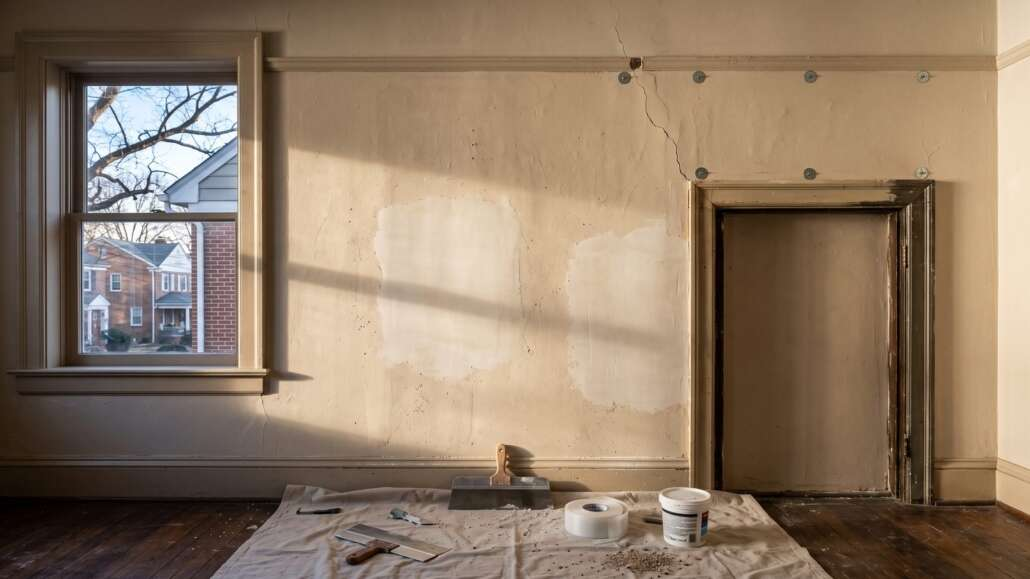
Repainting Inside a 1920s Arlington House, and What Plaster Changes
The canopy comes down in November, and the light inside an old Arlington house changes with it. On the streets around Five Points, and up through the subdivisions platted between the wars in Waverly Hills, the oaks and tulip poplars are big enough that a north-facing room spends the whole summer in green shade. Leaf drop gives those rooms their one honest season of daylight, and the north walls that never really dried out in August start drying now. That’s usually when the phone rings about interior work.
What people notice in that low sideways light, in a house from the 1920s, is plaster. A hairline running out of the top corner of a door opening. A patch somebody made years ago that dried a shade off and never disappeared. A soft place under the picture rail that sounds hollow when you knock on it.
Plaster is a better wall than anything hung since, and it’s part of why these houses still feel solid. It just doesn’t behave like drywall, and the difference shows up in the second year rather than on the day the job finishes.
What Is Actually Behind Your Paint
Two systems went into these houses, and they want different handling. The older one is wood lath: thin strips nailed across the studs with a deliberate gap between them, then three coats of plaster. The first coat gets pushed through those gaps and slumps over the back of the lath, and the slumps harden into keys. Those keys hold the wall up. A brown coat follows for thickness, then a thin lime finish coat that ends up harder than everything behind it.
By the late 1920s a lot of builders had moved to rock lath: gypsum panels nailed up like small sheets of drywall, then skimmed with plaster. Same finish, different guts, and a far more forgiving wall to repair.
You can usually tell which one you have by looking in a closet or at an attic knee wall, where nobody bothered to finish neatly. Most of the older houses we get into on painting jobs in Arlington have both, because the back end got added on at some point.
The Cracks, and Which Ones Actually Matter
Diagonals running out of the corners of door and window openings are the most common thing we see and the least alarming. An opening is the weakest line in a wall, and plaster splits there first when the framing moves with the seasons.
A long horizontal crack running dead straight for several feet is following a lath line, and it usually means keys have snapped off the back. Put your palm flat beside it and push. If the wall gives at all, the plaster has come loose from the lath, and filling that crack without re-anchoring the wall buys you about eight months.
You can feel it through the ceiling when a flexing section finally pulls back tight to the lath. A plaster ceiling that has moved for 90 years can go solid in about a minute of driving washers, and the rest of the repair is tidying up.
Fine map cracking across a whole wall, like crazing on old pottery, sits in the finish coat only, so it’s a skim-coat conversation rather than a patch conversation. Take a bulge with no crack in it more seriously, because that’s usually the finish coat separating from the brown coat behind it.
Which of those you have sets the prep level for the room, and that gets agreed before work starts rather than discovered halfway through. Our pre-paint preparation levels run 1 to 5 on the PDCA Industry Standard, and old plaster usually lands at Level 3 or higher because of the crack taping and the texture matching.
Plaster and Drywall, Step by Step
| Step | Drywall | Old plaster |
|—|—|—|
| Fixing a crack | Tape, three coats of compound, feather it wide | Re-anchor the wall first if it moves, then mesh tape, then a setting compound |
| Filler | Lightweight all-purpose compound | Setting-type compound, which cures chemically, shrinks less and doesn’t sink into a deep fill |
| Sanding | Sand freely, the paper face forgives it | Sand lightly, because the lime finish coat is harder than the brown coat behind it |
| Dust | Manageable | Heavy and gritty, so containment and floor protection matter more |
| Priming a repair | Spot prime | Prime the patch, then prime the wall, because bare plaster is alkaline and thirsty |
| Hanging anything | Anchors bite | Pilot-drill, since hammering into plaster cracks it around the hole |
| The look you want | Flat and uniform | Slightly wavy, and it should stay slightly wavy |
That last row is the one homeowners argue with. Plaster reads as handmade because it is, and flattening it to a modern standard means skimming every surface in the house. Walking the house is the only way to tell you which walls need that and which need three patches and a coat. Call (703) 253-9268 and we’ll come and look.
Priming Is Where an Old Plaster Job Gets Won
Suction is the whole story. Old painted plaster absorbs almost nothing. A fresh patch absorbs a lot. Roll color straight over both and the patch drinks the first coat, dries duller, and shows up as a shadow every time the sun swings around, which in a north-facing room is exactly the hour you’re sitting in there.
So repairs get primed, then the entire wall gets primed, and the surface under the color becomes one material with one rate of absorption.
Ceilings in these houses hold one more surprise. Some were finished with calcimine, a chalk and glue distemper that was standard before the war and was never meant to be painted over. Modern paint sticks to it for about a year, then lets go in sheets with a powdery back. What failed there isn’t the paint, it’s the chalk underneath, and the fix is washing it off rather than sealing it in.
Doing It in Winter, and Doing It in Order
Fall through early spring is when this work belongs indoors anyway. Cabinets, trim and whole-house interiors get done in the months when nobody wants to be on an outside ladder, and booking in that window means you aren’t waiting behind every exterior job in the county.
Sequence matters more in a plaster house than in a new one. Repairs first, and they have to dry properly, which in a heated house happens faster than people expect. Ceilings, then walls, then trim and doors last, so the line people actually look at gets cut once. Most of the interior painting we do in these houses is exactly that: a lot of preparation, then a fairly ordinary two coats.
Patrick’s Painting & Home Improvement is a small Alexandria company, and Arlington is a short drive north. The older streets around Cherrydale and Lyon Village are our favorite houses to work in, partly because no two of them carry the same trim profile. Colonial Revival, Tudor Revival, Craftsman and the odd American Foursquare sit on one block, and the millwork tells you which is which before you read the roofline. For the wider view, we’ve written up what an interior and exterior job in Arlington covers.
Frequently Asked Questions
How do you paint plaster walls in a 1920s Arlington house without opening new cracks?
New cracks come from vibration and pressure, not from paint. Each wall should be checked by hand first, and any section that flexes needs re-anchoring to the lath with plaster washers before a knife touches it. Sanding stays light so the hard finish coat survives, and fasteners get pilot-drilled instead of hammered. The repairs go in with a setting compound and mesh tape, because a soft filler moves with the crack and telegraphs through by spring.
Should we skim coat the whole wall or just patch it?
Patch it, in most rooms. A full skim earns its keep when the finish coat is crazed across the whole surface, or when a wall has been repaired so often that it reads like a quilt. Otherwise skimming costs you the texture that makes an old house look like an old house. We give you an answer wall by wall rather than one answer for the whole floor.
What is the powdery layer under the peeling paint on my ceiling?
That’s almost certainly calcimine, an old chalk-and-glue ceiling finish common before the war. Paint bonds to it for a season and then releases in sheets, taking your new coat with it. It can’t be sealed in reliably, so it gets washed off down to sound plaster and primed. Messy work, and it’s the only version that lasts.
Is spraying or rolling better on old plaster?
Both work, and the choice is about the room rather than the wall. Spraying lays down a very even film and it’s efficient in an empty house, but it needs full masking. In an occupied house with furniture and a lot of trim, rolling and back-rolling is cleaner, and on old plaster the dry finish is honestly no different.
How long does an interior repaint take in a house this age?
Longer than the same square footage in a newer house, and the extra time sits at the front. Plaster repair, drying, sanding and two priming passes can take as much of the schedule as the color coats do. A few rooms usually run a week, and a whole main floor with trim and ceilings runs longer. We give you real dates at the estimate.
If your house has plaster and you’d like it to stay that way, we’ll walk the rooms with you and say honestly which walls need real repair and which just need a coat. Patrick’s Painting handles the patching, the carpentry and the painting under one contractor, so nothing sits waiting on somebody else’s schedule, and the labor on every painting project we finish is guaranteed for five years. Call (703) 253-9268 and the walk-through costs you nothing.