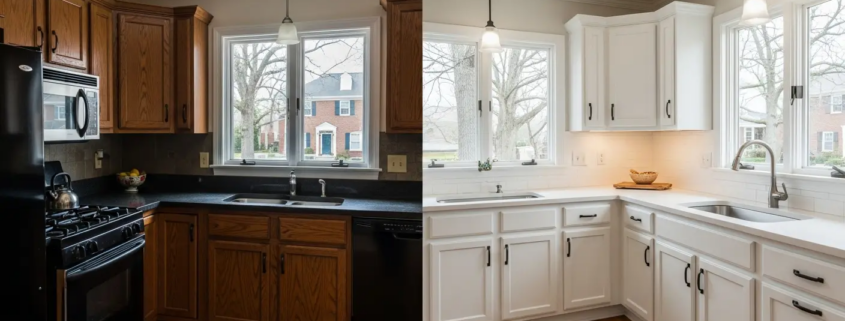

Painting Cabinets in Place: What It Involves When the Doors Can’t Go Outside
Fourth floor, no garage, no driveway, and an elevator shared with everyone else in the building. The kitchen is a galley: 11 feet of uppers and lowers, a pass-through into the living room, carpet starting about six feet from the range. Almost every article ever written about painting kitchen cabinets assumes you can pull the doors, carry them to a garage bay and spray them flat across a pair of sawhorses. A lot of kitchens around here don’t come with a garage bay.
Old Town North and Potomac Yard are mostly newer condo and townhome builds, and interior projects dominate there for exactly that reason. The cabinets are usually sound. What’s tired is the finish: oak under a varnish that has ambered toward orange, or a builder box that looks fine everywhere except the two doors either side of the range. South of there, in the Federal and Georgian rowhouses on our Old Town Alexandria page, the kitchens are older and the staging problem gets harder again.
So the question worth answering isn’t whether cabinets can be painted in place. It’s what changes when the work happens inside your home instead of somewhere else. Three things move: dust, dry time, and the order the doors come off. Everything else about painting in Alexandria stays the same.
What “In Place” Actually Means
Nothing gets painted hanging. The phrase misleads people in a way that costs them sleep, so it’s worth clearing up before anything else. Doors and drawer fronts still come off, still get labeled, and still get finished flat. What stays put is the box: face frames, stiles and rails, end panels and the toe kick, all of it screwed to a wall and going nowhere.
What changes is the room the doors dry in. Instead of a garage bay, the work area is a spare bedroom, a dining room, or a sealed-off half of the same kitchen. Plastic walls, taped seams, rosin paper over hardboard on the floor, and racks that hold the doors upright so both faces harden at once. For a galley kitchen that rack footprint runs about the size of a dining table, worth knowing before you agree to it.
Boxes get treated identically in both versions of the job. Hardware off, degrease, scuff sand, vacuum, bonding primer wherever the old finish is slick, then two finish coats. Face frames are the part your hand touches every day, so they get the same attention as the doors even though they never leave the room. The longer walkthrough of a kitchen refresh start to finish sits in our piece on cabinet painting in Northern Virginia.
In Place or Off Site: What Actually Changes
| | Doors finished on site | Doors finished off site |
|—|—|—|
| Where the boxes get painted | In your kitchen | In your kitchen |
| Containment | Sealed work area inside the home, air pulled out through a window | Kitchen containment only |
| Dust reaching the rest of the home | Controlled, but plastic stays up all job | Less, door sanding happens elsewhere |
| Doors leaving the building | They don’t | Elevator, hallway and truck, twice |
| Before the kitchen is usable | Days, not hours | Days, not hours |
| What sets the pace | Cure time | Transport windows and cure time |
| Best for | Condos and upper floors | Homes with a garage bay or basement shop |
Condo cabinets are good winter work. To find out which column yours falls into, call (703) 253-9268 and we’ll look at the boxes, the doors and the hinges and put a free estimate together.
Dust, and the Part People Underestimate
Sanding cabinet boxes indoors makes a fine dust that goes wherever air goes, which is everywhere. Containment is the whole game. Zip walls at every opening, seams taped, HVAC returns inside the work zone covered over, and a fan set in a window pulling air out so the pressure inside runs negative. Sanders run with a vacuum attached rather than a dust bag, and the vacuum matters more than the sander does.
Odor is the other question. Waterborne enamels smell far less than the old solvent alkyds and they’re what belongs in an occupied home, but less isn’t none. If somebody in the house is sensitive, say so at the estimate and the schedule gets built around it.
Buildings have opinions too. Elevator pads, hallway runners and a protected path from the entrance to the unit are ordinary requests, and they get arranged before day one instead of discovered on the morning of it.
Dry Time, Hardware, and the Order the Doors Come Off
Labeling is unglamorous, and it’s the difference between a clean reinstall and an afternoon of shimming. Every door and drawer front gets a number on tape inside the hinge mortise where no paint will reach it, and a map of the kitchen goes inside one of the cabinets. Doors go back exactly where they came from, because 30-year-old hinge screws have made their own holes and want no new ones.
Hinges decide part of the sequence themselves. European cup hinges come off and go back on, and paint build inside the cup shifts the reveal enough that every door needs adjusting at the end. If you’re changing pulls, old holes get filled and new ones drilled before any finish goes on.
Dry versus cured is where most of the disappointment lives. Enamel is dry to the touch in hours and genuinely hard in days. Doors go back up early so you have a kitchen again, but bumpers stay off and nothing heavy leans against a door face until the film has hardened through. Stack plates on a shelf on day two and you’ll be looking at that ring for years.
The second morning is worth being in the room for. The first rack comes off the finish coat, and the grain that’s been reading orange since before anybody in the building moved in is simply gone. Same cabinets, same 11 feet of galley, and the kitchen reads twice the size.
Whether Your Cabinets Are Worth Painting At All
Substrate decides this before anything else does. Solid wood and plywood boxes take paint and keep it. Thermofoil and melamine are a different conversation, because the finish has to bond to a plastic film rather than to wood, and on some doors it won’t hold whatever goes underneath. MDF is fine unless the bottom edges have swollen from water, which happens under sinks and beside dishwashers.
Grain is the other honest variable. Open oak grain telegraphs straight through paint, so you either fill it and get a smooth modern face or you accept the texture and let the doors read as painted wood. Both are legitimate, and only one is what people picture when they say “painted white”, so it gets settled out loud at the estimate.
Where the boxes themselves are failing, sagging shelves, broken slides, a soft floor under the sink, paint is money in the wrong place. That’s the real question behind whether to paint or replace them. Cabinet work sits inside our home improvement side along with the carpentry and re-caulking that tend to arrive with it. Fall through early spring is when this work gets done, and the reason is simple: the kitchen is the one room nobody wants torn up in July.
Frequently Asked Questions
Can kitchen cabinets be painted properly in a condo with no garage or driveway?
Yes, and winter suits it well in the condo and townhome stock around Old Town North. The doors and drawer fronts still come off and get finished flat, just on racks inside a sealed work area rather than a garage bay. That area is usually a spare bedroom or a partitioned section of the kitchen, with plastic walls, floor protection and a fan pulling air out through a window. The finish quality doesn’t change; the containment does.
What happens to the cabinet boxes if only the doors come off?
They get finished where they are: face frames, stiles and rails, end panels and the toe kick, all of it screwed to a wall. Boxes are brushed and rolled rather than racked flat, so the containment and the dust control matter more than they would in a garage. Under raking light a face frame reads very slightly different from a door that was finished flat, and that’s what an in-place job looks like up close. The doors and drawer fronts still come off, still get labeled and still get finished flat somewhere else in the unit.
How much dust does painting cabinets inside the house actually make?
Sanding makes plenty of it, which is why containment goes up before a single piece of hardware comes off. The work area gets sealed with plastic and tape, HVAC returns inside it get covered, and a window fan pulls air outward. Sanders run with vacuum attachment rather than a collection bag. Done properly, you’ll find dust in the work area and effectively none in the rest of the unit.
When can I put the dishes back and start using the kitchen again?
Sooner than you can load the shelves heavily. Doors go back on once the film will take handling, so the kitchen works like a kitchen again fairly quickly, but enamel keeps hardening for days after it stops feeling tacky. Bumpers, shelf liners and anything with real weight wait for the cure rather than the dry. Something pressed into a soft film leaves its outline there permanently.
Are oak cabinets with heavy grain worth painting, or does the grain still show?
The grain shows unless it gets filled, and both outcomes have people who want them. Filling open oak grain adds a pass of filler and a full sanding cycle, and gives you the smooth modern face most people picture. Leaving it gives you painted wood that still reads as wood, which suits a traditional kitchen. We settle that at the estimate, because it changes the scope.
Cabinets are a good winter project and a bad guess. Call (703) 253-9268 for a free estimate and we’ll agree the pre-paint preparation level with you before work starts, against the PDCA Industry Standard P14-06 that every Patrick’s Painting project is scoped to. The labor on all painting projects we complete is guaranteed for five years.