
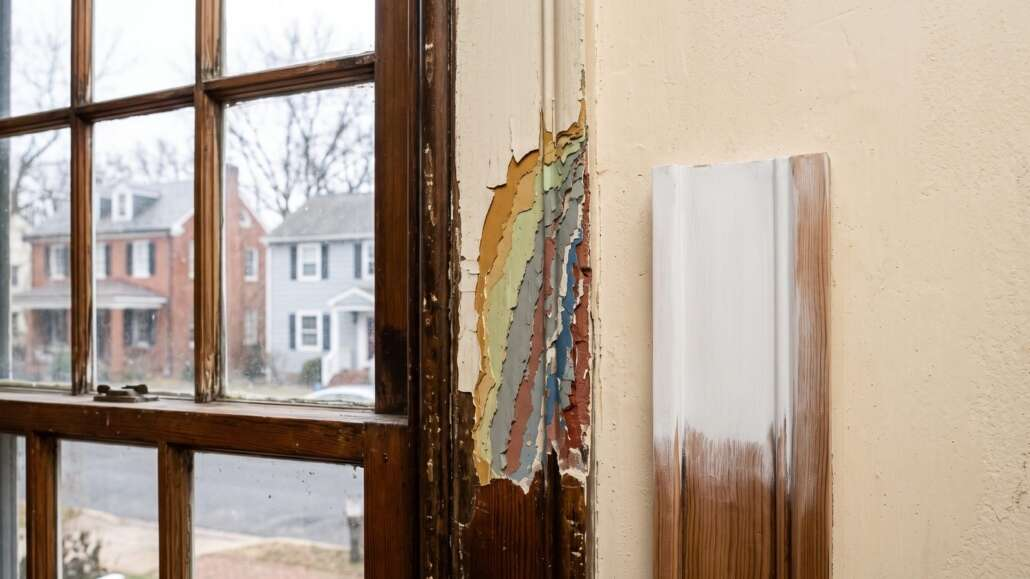
A Century of Paint on Rosemont Trim, and What It Takes to Get a Clean Line Again
Take one window casing in a Rosemont foursquare. Nine coats on it, maybe 11. Nobody counted. The bead that ran around the outer edge when the house was built is now a soft rounded ridge with no shadow in it. Somebody has cut in against that casing a dozen times over a century, and every cut left another edge of paint sitting slightly proud, so the line where the wall stops and the trim starts isn’t a line any more. It’s a shelf about a sixteenth of an inch tall.
Rosemont was laid out as a streetcar suburb between 1900 and 1920, and the Rosemont Development Company started selling lots in the 84-acre neighborhood in 1908. The houses went up between 1908 and 1941: Colonial Revivals, Craftsman bungalows, American Foursquares, Arts and Crafts. Roughly bounded by Commonwealth Avenue, West Walnut Street, Russell Road, Rucker Place and King Street, and most still carry their original millwork. It’s one of the older pockets we work in across Alexandria.
All that accumulated paint is the job. Interior work in a house this age is a millwork problem before it’s a color problem: get back to a surface that will take a clean line, then get the line.
What Edge Build Does to a Profile
Every coat is one to three thousandths of an inch once it’s dry, and paint doesn’t lie down evenly. It runs thin over the high points of a profile and pools in the coves. Do that 10 times across a century and the shape the millwork was cut to have fills in. The ogee flattens. The bead loses its shadow line. The quarter-inch reveal at the edge of a stile, the flat that catches light and tells your eye where the trim begins, disappears under the build.
You see the result before you can name it. A room of original trim that has gone soft reads as slightly out of focus, and people call it tired without knowing why. It’s lost geometry, and it’s why a fresh coat over the top never solves anything. It’s also the most common condition painters in Alexandria meet in the pre-war neighborhoods.
Why It Fails at the Edges First
- Film thickness has a ceiling. A coat that goes on too thick skins over before the underside catches up, and that stored stress cracks it later.
- Every layer is a different product. Oil under latex under oil under whatever was on the shelf in 1974, and those layers move at different rates and shear against each other.
- Old oil goes hard and glassy. Latex brushed over aged, unsanded alkyd has nothing to key into, so it sits on top like a decal and lifts in sheets when a fingernail catches an edge.
- Corners take the abuse. Casings get shouldered, baseboards get vacuumed, window stops get pushed, and those are the places the film is thickest and least supported.
- Caulk is doing work it can’t do. A quarter-inch bead bridging casing to plaster stays flexible for a while, and when it splits the paint splits with it.
In a house this age, two rooms of original trim can want two different approaches. Call (703) 253-9268 and Patrick’s Painting & Home Improvement will walk it casing by casing, free of charge, before anybody talks about color.
Getting the Line Back
Three ways to take paint off original millwork, and they aren’t interchangeable. Chemical strippers work down into a profile and take it back to wood, which is what a piece with its shape gone needs, and they earn their time on a front door or a stair rail. Heat lifts the film in ribbons and moves fast on flat runs, with real care needed around glazing. Sanding is the everyday answer on readable trim: knock the build down, feather the failed edges into sound paint, stop.
Not every piece needs to go to bare wood, and pretending otherwise turns a two-week job into a two-month one. Sound film over a soft profile gets sanded and recoated. Failing film over lost geometry gets stripped. Paint made before 1978 can contain lead, and that changes the method any painter has to use on it rather than the plan for the room. It gets settled before sanding starts, not after.
Feathering separates a repair you can see from one you can’t. Where paint has let go, the edge of what’s left is a cliff, and it gets sanded into a shallow ramp wide enough that your fingertips can’t find it. Prime, then check again with a light held flat to the surface before any topcoat. Trim east of here in the rowhouses runs the same way, and that stock has its own page for painters in Old Town Alexandria.
Primer does the rest. Over aged alkyd, something that grips a glassy surface. Over wood gone chalky at the face, something that penetrates. Over water stains and knots, a stain blocker, because tannin in a century-old pine casing comes through two coats of white within a month.
Nothing on a job like this beats the first primer coat on a casing that’s just been stripped. Ghosting, ambered patches and 40 years of touch-up vanish at once, and for an hour that one piece of trim looks better than the rest of the house by a mile.
The Prep Levels, Read Against a 1920s House
Prep levels aren’t a marketing ladder. They’re the PDCA Industry Standard P14-06, they run 1 to 5, and we agree one with you before a brush comes out of the truck. On original trim the difference shows from across the room five years later. Full descriptions sit on our pre-paint preparation levels page.
Level 1, Basic, is cleaning and removing loose paint with no patching, and it carries no warranty, which we say before anybody asks. Level 2, Standard, covers an adhesion assessment, basic patching and filling, spot priming, caulking and sanding above 1/8 inch: an honest scope on sound bedroom trim.
Most Rosemont trim with edge failure lands on Level 3, Superior, which adds detailed patching, crack taping, texture matching and sanding above 1/16 inch. Level 4, Supreme, means thorough filling and sanding above 1/32 inch, and it’s what a front hall with a big window and a stair run wants, because raking light finds 1/32 of an inch easily. Level 5, Restoration, is near-complete paint removal and substrate replacement: the front door, the stair rail, the bay window that has leaked for a decade.
Beverley Hills and Seminary Hill: Same Streets, Different Problem
North Ridge, which Beverley Hills sits inside, was built mainly between the 1930s and the 1960s, and the stock changes the work. Tudor revivals and 1930s and 1940s colonials put three surfaces on one elevation: shake siding, stuccoed half-timbering, and slate trim work. Each wants its own prep and its own product, and the common mistake is treating that elevation as one surface because it’s one wall.
Seminary Hill, out toward the Virginia Theological Seminary and Episcopal High School, is a different problem again: mid-century brick ramblers, Cape Cods and split-levels built between 1948 and 1968. Simpler profiles, younger trim, almost none of the layered-paint history. Those houses want interior refresh work, and the walls matter more than the millwork. The wider view of interior and exterior painting across all three neighborhoods is worth reading before you scope a job.
Frequently Asked Questions
Why does new paint on old Rosemont trim start peeling at the edges within a year?
Because the new coat had nothing to bond to. Aged oil paint cures hard and glassy, and latex brushed over it without sanding sits on the surface rather than keying in. Edges make it worse, since paint builds thickest where a brush stops and thick film at an edge takes the most contact. Scuff sanding and a bonding primer over old alkyd is what stops it.
Does original trim have to be stripped to bare wood, or can it be sanded and recoated?
Most of it can be sanded and recoated. The test is whether the profile still has its shape and whether the film is sound. Sound paint over a softened profile gets knocked down, feathered and recoated, which is faster and gentler on the wood. Stripping is for pieces where the shape has gone or the film is failing across the run.
Can the original profile be brought back once the paint has filled it in?
Yes, though it means removing build rather than adding to it. On a stripped piece the cove, the bead and the reveal come back exactly as they were cut, and the difference in a room is bigger than people expect from a paint job. Sanding alone recovers part of it, and which pieces get the full treatment is decided room by room.
What sheen works best on original trim in an older Alexandria house?
Satin or a low semi-gloss on trim of this age. High gloss looks sharp in a photograph and shows every ripple a century of repainting has left, and on trim that’s been sanded rather than stripped there will be ripple. A lower sheen still cleans well and reads as woodwork rather than plastic. We look at the profiles and the light before recommending one.
Is it worth painting original stained woodwork, or should it stay natural?
It depends on what’s under the finish and how much is left. Quartersawn oak with the original shellac intact is usually worth reviving rather than painting. Softwood varnished and patched for decades, or one surviving room of it, is a defensible thing to paint. It’s a one-way decision, so we talk it through rather than treating it as a line item.
Old trim rewards patience and punishes shortcuts, and the only way to know what your house needs is to stand in front of it. Call (703) 253-9268. The estimate is free, and the preparation level gets agreed room by room on the PDCA Industry Standard P14-06 before anything is scheduled. Patrick’s Painting was named Best of Houzz 2025.