
The Repaint Before You List, and the One After You Buy
Paint the rooms a buyer stands still in, and leave the rest. That’s the rule, and most people run it backwards. They repaint the guest bedroom nobody photographs, then skip the entry hall, which is where somebody forms an opinion about the house in roughly four seconds.
North Arlington turns over on somebody else’s calendar. Plenty of households up here move on federal and military timing rather than on a read of the market, so orders and school years set the dates and the listings stack into a short window.
If you plan to list in the spring, the painting happens in January and February, while the house is still yours to live in and nobody’s photographing it. Buyers coming the other direction have an easier job and usually waste it. You close, the house sits empty for a week or two, and that’s the cheapest painting window you’ll ever get. Both repaints are worth doing well, and they aren’t the same job.
What a Buyer Is Actually Looking At
A listing gets judged twice, once on a phone screen and once in the doorway, and the two judgments are made on different things.
On the screen it’s the walls and the ceilings, because a wide-angle lens flattens everything else. A yellowed ceiling in a north-facing room photographs gray. A wall with four patched nail holes and no repaint photographs as a shadow. Anything with a water stain photographs as a problem.
In the doorway it’s the trim. People run a hand along a stair rail without deciding to, and they look at the door edge next to the knob, the baseboard by the kitchen, the casing where 30 years of hands have gone. That detail is what makes a house read as cared for, and it gets skipped most often because it takes the longest.
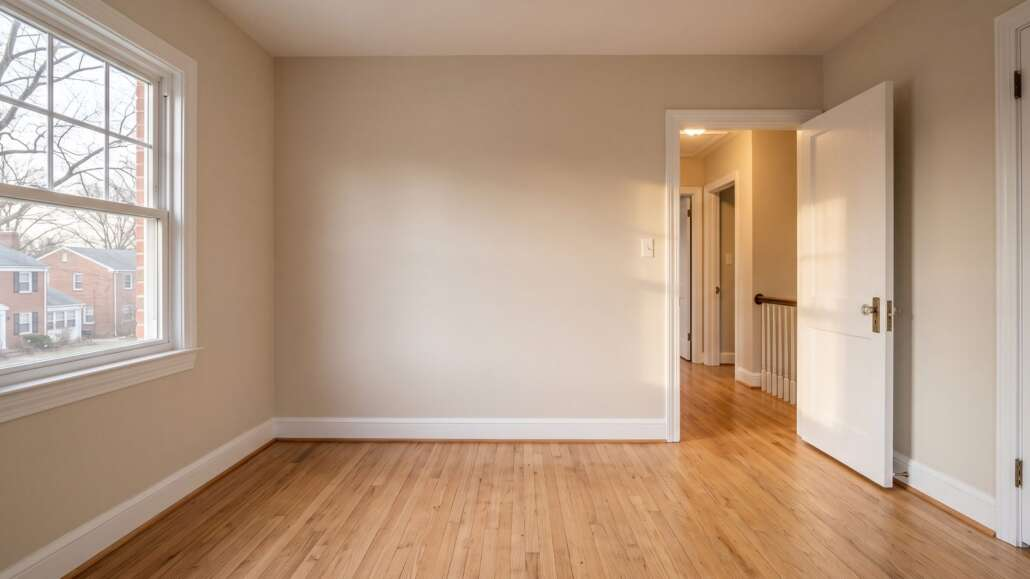
There’s a quick test. Stand in a room at midday with the lights off and look at the wall opposite the window. If you can see roller lines, touch-ups or old furniture shadows from there, a buyer will see them too. Every one of the signs a paint job has run out of time shows up harder in a listing photo than it does in life.
The Pre-List Sequence
Order matters here more than product does. Run it like this:
- Chase every stain to its source before you cover it. A ceiling ring is a leak until somebody proves otherwise. Painting over an active one hides it for about six weeks, which is exactly long enough to reach a home inspection.
- Carpentry before paint, always. A split casing, a soft sill, a baseboard that has pulled away, a door that was never rehung properly. Paint over bad wood reads as paint over bad wood, so carpentry and home improvement work comes before the brushes.
- Pick one wall color and run it through the public rooms. One color moving through connected spaces makes a house feel larger on a walkthrough and cleaner in photos than three coordinated colors do. The color visualizer narrows it down, and real samples in your own light settle it.
- Ceilings only where they read. Kitchens, bathrooms and any room with a stain or a smoker’s cast. Whole-house ceilings before a sale is money spent where the camera isn’t pointed.
- Walls, then trim and doors. Cut the wall color roughly toward the trim, then cut the trim line clean over it at the end, so the line people look at gets made once.
- The front door last. It’s the first surface a buyer touches, so it should arrive at the showing without a mark on it.
- Leave the leftovers labeled. Room name on the lid, in marker. Buyers notice, agents mention it, and it costs you nothing.
- Photograph after it cures, not the afternoon it dries. Enamel keeps hardening for days, and a fresh sheen photographs hot and blotchy under a photographer’s lights.
You’ll get further with a list somebody has actually walked than with one put together off a floor plan. Call (703) 253-9268 and we’ll go room by room and mark what changes a showing.
What to Leave for the Buyer
Not everything should be neutralized. A dining room in a strong color, well painted and not chipped, does a house more good than a fifth beige room. Kids’ rooms get forgiven by everybody who has had kids.
Wallpaper is the one to think hard about. Stripping it either goes smoothly or takes the top layer of drywall paper with it and turns into a skim-coating job across three walls. If it’s flat, tight and inoffensive, leave it. If it’s lifting at the seams, deal with it properly or price the house knowing it’s there.
The Repaint After You Buy
An empty house is worth more to a painting crew than any other condition, and new owners almost never use it. No furniture to move, no rugs to protect, no working around bedtimes. Ceilings, walls, trim and doors through a whole floor can happen in the days between closing and the truck arriving.
Older detached houses across Arlington hand you one specific problem in that first month, and the streets around Yorktown and Rock Spring are full of it. A house that got an addition later has two paint histories under one roof. The original half might carry decades of oil-based enamel on the trim, while the newer half carries latex over a factory-primed profile. The same wall color goes onto both and dries looking like two colors, because the sheen and the substrate underneath aren’t the same.
That mismatch is fixable, and the fix is prep rather than paint. Older trim gets degreased and scuff-sanded so a new coat has something to hold, a bonding primer goes over anything glossy or previously oil-based, and then both halves take the same finish coat. That’s the part of a house like that we actually look forward to. You stand in the doorway afterward and genuinely can’t tell where the original house stopped.
The gambrel-roofed Dutch Colonial Revivals scattered through Waverly Hills have their own version upstairs. A sloped ceiling plane runs down into a knee wall with no crisp corner to cut to, so the line gets laid out and held by hand across the room. Nobody notices it when it’s right.
Getting a Real Number Before You Commit
One thing to watch: a whole-house price quoted over the phone off a square-footage figure. Nobody can see a water ring, a soft sill or 40 years of paint built up on a door edge from a phone call, so that number always moves once somebody walks the house, and it moves at the worst possible moment.
Every estimate we do is free and it happens at the house. We walk room to room, count the doors, press on the sills, look at the ceilings from underneath and tell you which parts of your list will change a showing and which ones won’t. Then you get it in writing, with the prep level for each surface agreed up front rather than discovered halfway through. Patrick’s Painting & Home Improvement has been serving Northern Virginia since 2009, and that conversation hasn’t changed much in all that time.
For the wider picture of what we handle up here, our Arlington interior and exterior services page covers the full scope.
Frequently Asked Questions
Which rooms are worth repainting before you list a house in North Arlington?
Start with the entry and the stair hall, because that’s where a buyer forms an opinion before seeing anything else. Then the kitchen, the primary bedroom and any room with a stained ceiling or a color that reads as personal. Trim and door edges through the main floor come next, since that’s the detail people touch on a walkthrough. Guest bedrooms, basements and utility spaces are usually the ones to skip.
Should we repaint the whole house or only the rooms that show?
Only the rooms that show, in most cases. A house that’s fresh in five rooms and untouched in three reads as well cared for rather than as staged. The exception is one wall color running through connected spaces, where repainting three of four rooms leaves an obvious edge. We flag that at the estimate.
How soon after closing should a buyer repaint?
Before the furniture arrives, if you possibly can. An empty house means no moving, no covering and no working around anybody’s schedule, so a whole floor gets done in a fraction of the time. If that window has passed, the next best moment is before rugs and window treatments go in, because those are what make masking slow.
Can you match the paint on an addition to the original part of the house?
Yes, and the work is almost all preparation rather than color. Old trim in the original half is often oil-based and glossy while the addition carries latex over a factory-primed profile, so one color dries looking like two. Degreasing, scuff-sanding and a bonding primer put both halves on equal footing, and the finish coat then reads as one house.
What wall color works best for listing photos?
Something warm and light, held through the connected rooms, in a flat or matte sheen. Flat photographs evenly under a photographer’s lights, while eggshell and satin throw hot spots that look like damage on screen. Trim goes clean white in semi-gloss so it separates from the wall. Try samples on your own walls first, because north-facing rooms in Arlington pull cool.
Either way, selling or just handed the keys, the visit is the same. We come out and tell you honestly what’s worth painting and what isn’t. Patrick’s Painting is an Alexandria company working across Northern Virginia, and we were named Best of Houzz 2025. Call (703) 253-9268 to set up a free estimate at the house.