
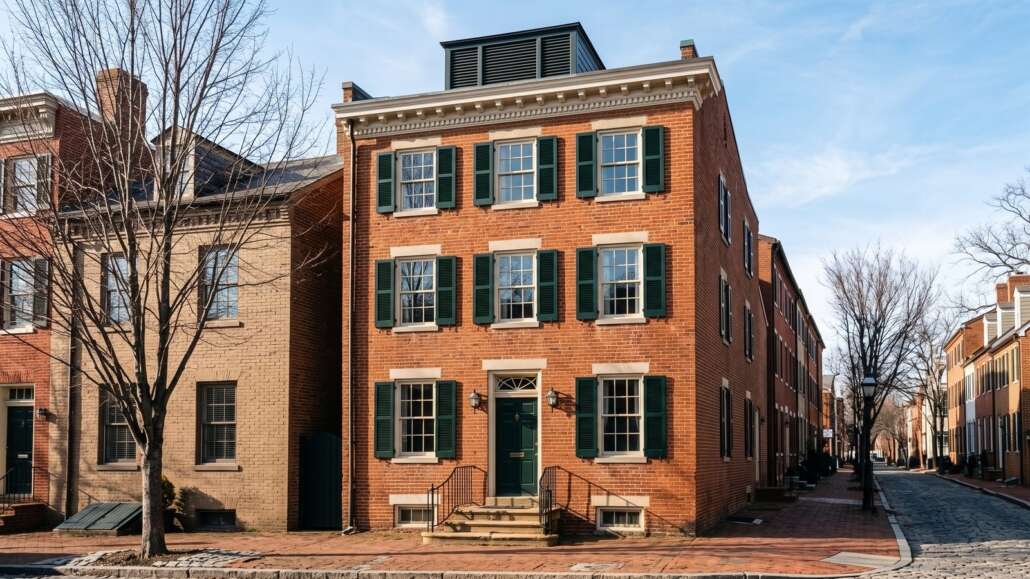
What the Board of Architectural Review Actually Reviews on an Old Town Repaint
Ask a few neighbors on Wilkes Street whether the city has to approve the color of their front door and most will say yes. They’re wrong. The Board of Architectural Review doesn’t review paint color in Old Town, and never has.
Alexandria puts repainting in the ordinary maintenance column. Two lines from the city’s own adopted policy settle it: “Painting or repainting non-masonry surfaces” and “Repainting masonry surfaces that are already painted.” Both sit on the list of jobs that need no approval at all.
That’s worth real money to somebody who owns a 200-year-old brick front. People put a repaint off a full season because they think a review process stands in front of it. In almost every case it doesn’t. There’s one job where it does, and it’s covered further down.
Repainting Is Maintenance, and Maintenance Doesn’t Get Reviewed
Three parts of a normal Old Town repaint sit outside review entirely.
Wood comes first, and it’s most of what gets painted on a rowhouse front anyway. Shutters, the entry door and its surround, window sash and casing, the cornice, dormer cheeks, porch decking, iron rails. Repainting any of it on an exterior job is between you and your painter.
Painted masonry is second. A brick front somebody painted in 1974 is a painted surface now, and repainting a painted surface is maintenance. Same for stucco over masonry.
Color is third, and it’s the one that catches people out. There’s no district palette. The Board holds no approved color list and doesn’t sign off on the shade you pick. If you hear about approved colors for the historic district, that list came from a paint company. The city doesn’t publish one.
Review only covers exterior work visible from a public way, and that’s narrower than it sounds here, since alleys run behind half these blocks.
What Does Need Approval Before Work Starts
Here’s how the common exterior jobs sort out.
| The work | Approval needed first? | Why |
|—|—|—|
| Repainting shutters, doors, sash, cornice and porch | No | Ordinary maintenance |
| Repainting brick or stucco that’s already painted | No | Ordinary maintenance |
| Choosing the color | No | Color isn’t reviewed, in the district or out |
| Painting brick or stone that has never been painted | Yes, before work starts | A permanent change to historic masonry, and the Board discourages it |
| Exterior alterations visible from a public way, like new windows | Yes | The Board reviews alterations visible from a public way |
| Taking down more than 25 square feet of the building | Yes, separately | Demolition rules apply, visible or not |
If you’re standing in front of your own house and can’t tell which row it lands in, Patrick’s Painting & Home Improvement will come look at it with you. Estimates are free and we do them at the house. Call (703) 253-9268.
The One Job That Needs Approval, and Why We’d Talk You Out of It
Painting brick that has never been painted needs approval from the city before work starts, and the Board discourages it. The trade reasoning lines up with the rule.
Soft historic brick and lime mortar move moisture. Water gets in, then leaves through the face of the brick. Put a paint film across that face and the water still gets in, at the roof, at a failed sill, through open mortar joints, and now it has nowhere to go. It sits behind the film through a January freeze, expands, and takes the brick face with it when it lets go. That’s spalling, and it doesn’t repair cheaply.
Painting brick is also a one-way door. Stripping it back off old masonry is aggressive work on a soft surface and rarely comes out clean, so what you’ve signed up for is repainting that wall every so often for as long as you own the house.
We give the same answer on 1960s brick ranchers in Rose Hill, where no review board exists at all. If the brick is sound, leave it. Put the money in the trim, sills and cornice, because that’s where the failure is.
How to Find Out Whether Your House Is in a District
Two districts, plus a category most people have never heard of.
The Old and Historic Alexandria District runs roughly from Hunting Creek in the south up to Bashford Lane in the north, and from the Potomac west to near the King Street Metro. The Parker-Gray District sits beside it, a 40-block area named for the Parker-Gray School, which opened in 1920 and honored John Parker and Sarah Gray, two principals of Alexandria’s segregated schools. Residential work there follows its own guide, and the repainting answer comes out the same.
Then there’s the one people miss. City Council can designate an individual building as a One Hundred Year Old Building by ordinance, and it then falls under the Board despite sitting outside both districts. Not every 100-year-old house carries it, and you can’t tell from the sidewalk which do.
So don’t guess, and don’t rely on what a neighbor remembers. The city keeps a historic preservation map viewer. Put your address in and in about two minutes you’ll know which of the three applies, if any. Rules shift more than the housing does across this city, and the Alexandria neighborhoods we work in run from the waterfront out to the West End.
What Actually Fails on a 200-Year-Old Brick Front
Winter here swings above and below freezing, sometimes inside a single day. Every cycle works the caulk joints, and on a rowhouse front the ones that matter are at the window heads. Water sits on the top edge of a head casing, gets behind a caulk line that shrank in the cold, freezes overnight and opens the joint another fraction. Run that a few winters and you’ve got wet wood behind paint that looks sound from the sidewalk.
In rough order, what goes first on a Federal or Georgian front: caulk at the window heads, the sills, the bottom rails of the shutters and their hardware, the entry door and threshold, then the cornice return where the roofline dies into the neighbor’s wall. Our guide to painting homes in Alexandria runs the same order on other housing stock.
None of it looks dramatic, and all of it stays cheap when you catch it early. A sill caught at the first soft spot is a scarf-in repair. Two winters later it’s a replacement, and that means matching a profile nobody stocks.
Shutters repay the work more than anything else on the front. They come off and get worked flat on horses, bottom rails spliced where water sat in them, hardware soaked and wire-brushed back to iron. Hang the pair again and the whole front squares up, and nobody walking past can tell you why the house suddenly looks right.
How far the prep goes is a decision, not a guess, and we make it with you first. Our pre-paint preparation levels run 1 to 5, and a front with two centuries on it rarely belongs at the bottom of that range. The labor on our painting projects carries a five-year guarantee.
Frequently Asked Questions
Do I need Board of Architectural Review approval to repaint my house in Old Town Alexandria?
No, in almost every case. The city lists repainting non-masonry surfaces, and repainting masonry that’s already painted, as ordinary maintenance needing no approval, and the color you pick isn’t reviewed. The exception is painting masonry that has never been painted, which needs approval from the city before work starts. If your house sits outside both districts and carries no One Hundred Year Old Building designation, the Board has no say at all.
Can I paint brick that has never been painted on an Old Town rowhouse?
Only with approval from the city, and the Board discourages it, so plan on hearing no. We’d steer you away regardless. Soft historic brick and lime mortar move moisture out through the face, a paint film traps it, and that shows up as spalled brick after a hard winter. It’s close to permanent too, since stripping paint off old masonry rarely comes out clean.
How do I find out whether my house is inside the historic district?
Look it up on the city’s historic preservation map viewer, which takes about two minutes. Three things can put a property under the Board: the Old and Historic Alexandria District, the Parker-Gray District, or an individual One Hundred Year Old Building designation. Age alone doesn’t decide it, since plenty of century-old houses carry none. We won’t tell you which one your address is, because the map viewer will.
How do you paint a rowhouse front with no driveway and no side yard?
Everything stages off the front, so the plan starts with the sidewalk rather than the paint. A rowhouse job needs containment under the work area and a walking lane kept open, and the cornice and upper sash usually come off ladders, since a narrow street won’t take bigger equipment. A wall can’t be left open overnight above a public sidewalk, so the work runs in sections and each one gets closed by day’s end.
What drives the cost of repainting an Old Town rowhouse?
Surface condition first, meaning how much trim is sound and how much needs repair before anything gets painted. Then the prep level we agree on, the shutter and sash work, any color change, access on a narrow street, and how many stories the front runs. Two rowhouses on one block can be very different jobs once you’re at the cornice. We measure it on site and put it in writing.
Planning an Old Town repaint for spring? The prep level gets agreed before anybody opens a can, using the 1 to 5 standard on our preparation levels page, so you know what’s happening to the sills and shutters before a brush touches them. Patrick’s Painting is based in Alexandria, so Old Town isn’t a market we drive out to. Call (703) 253-9268 and we’ll come and read the front with you. The estimate is free.